Payer Contracting
Payer Contract Negotiations: How Providers Can Gain Leverage
For decades, healthcare negotiations occurred largely in the dark. Providers negotiated contracts one payer at a time and treated each renewal as a separate event. Payers, on the other hand, negotiated hundreds of contracts simultaneously. They typically knew what providers would and wouldn't accept.
Transparency in Coverage data has started to change that. Providers can now see what payers have agreed to pay comparable provider organizations for the same services.
This article explores why pricing discipline matters, what can weaken a provider's negotiating position, and how to prepare for the next renewal.
What Is Price Discipline?
When we talk about price discipline, there's an important distinction:
The goal is not identical reimbursement from every payer.
That is neither realistic nor necessarily desirable.
Pricing discipline also isn't refusing every payer proposal, blindly insisting on substantially above-market increases, or assuming your rates are fine because you went through a renewal cycle last year.
Pricing discipline is moving intentionally toward reasonable consistency in negotiated rates, with reimbursement that reflects the value of the service provided and your position in the market.
Why Is Pricing Discipline Important in Payer Contract Negotiations?
One way to guide toward rates that reflect the value provided is to use market data to decide which reimbursement rates to accept.
A payer's offer can increase your revenue and still leave you earning less than comparable providers for the same services. Knowing what that payer pays your peers also gives you a way to assess its explanation for the rates it offers for your services.
Revenue Can Rise While Rates Stay Below Market
When a payer proposal arrives, the managed care team typically takes four steps:
- Review the offered rates and terms.
- Compare them with the current contracted rates and terms.
- Calculate the revenue impact.
- Decide whether the projected change in revenue is acceptable.
What's often missing is a comparison with what the same payer reimburses comparable providers for the same services. Without that outside reference, the review can only show how a proposal compares with your own contract history, not how your rates compare with the market.
A Payer's Explanation for Its Rates Can Be Hard to Justify
It's easy to take a payer's explanation at face value when each payer brings different patient volumes, populations, employer arrangements, and strategic value to your organization. Your role in each payer's network can also vary.
Some of those factors can be difficult to validate. Employer arrangements, including administrative services only (ASO) agreements, can change, and provider consolidation can shift market dynamics. Knowing how the payer reimburses providers across your market gives you a reference point for assessing its explanation before negotiations begin.
What Weakens a Provider's Position in Payer Contract Negotiations?
Letting a legacy contract renew without a rate review, accepting an opening offer under time pressure, and negotiating without reliable peer benchmarks can all weaken your position. Even when you have market data, it's easy to misread it. If your benchmarks include rates for different services or provider types, a proposed increase can look more competitive than it is.
Many providers still approach payer negotiations one contract at a time. The question is often "What's the best deal we can get from this payer in this renewal cycle?" A low rate you accept today can become the starting point for your next renewal with that payer. A different payer may also use it to justify its own offer.
Letting Legacy Contracts Renew Without a Rate Review
One of the most common sources of pricing inconsistency is the legacy contract. Many provider organizations maintain agreements negotiated years ago, under different leadership and market conditions, and before negotiated rates were publicly available. Those contracts often contain reimbursement structures that no longer align with organizational strategy.
An evergreen clause can keep those terms in place. The payer has little incentive to flag a low rate. If the managed care team misses the deadline to give notice, the contract can renew automatically for another term at those existing rates.
Take a mid-sized multispecialty physician practice in New England. Its two national payer agreements had gone seven and nine years without renegotiation, respectively. The practice typically renegotiated its regional agreements every three years. Over time, the rates in the auto-renewing agreements slipped relative to what the regional plans paid for the same services.

For CPT code 99213, the two national payers reimbursed the practice at 121% and 103% of the locally adjusted Medicare rate. The three regional plans paid between 169% and 217% for the same service.
Accepting the First Proposal Under Time Pressure
A two-week response window, a looming budget deadline, or reluctance to issue a notice of nonrenewal can all put pressure on a managed care team to accept the payer's opening offer. That can leave little time to assess the financial impact, check the proposed rates against the market, or prepare a counteroffer. If the existing rates are already low, even a small increase will continue to carry much of that gap into the next contract term.
Negotiating Without Peer Benchmarks
Comparing a proposal with your current contracted rates tells you how much more the payer is offering. But your current rates are just your history with that payer. They reflect every concession you've made and every renewal you've let slide. Using only your current rates as your benchmark is how below-market rates compound over time.
To assess whether the offer is competitive, compare it with what the same payer reimburses comparable providers in your market for the same services. If the proposed increase still leaves you below those peers, you have a strong basis for a counteroffer.
Underestimating How Payers Use Your Lowest Rates
When you negotiate one contract at a time, questions like "What did we get from Cigna this cycle?" and "What is UHC offering?" become the norm. Each negotiation feels separate. Yet a concession you make under time pressure can become the starting point for your next renewal cycle with that payer.
Payers query Transparency in Coverage data too. A different payer preparing its own offer can see what you've accepted from another carrier for the same service. It may be far more interested in why that insurer pays you materially less than in discussing your highest-performing agreement. If it points to the lower rate to justify its own offer, your lowest rate can become your most important rate in the negotiation.
How Providers Can Gain Leverage in Payer Contract Negotiations
Providers can gain leverage in payer contract negotiations by reviewing agreements before notice deadlines, comparing proposed rates with what the same payer pays comparable providers, and documenting what their organization contributes to the payer's network.
Pricing discipline means having an external reference point before the payer calls. By the time the opening offer arrives, your team should know which rates it wants to change, what comparable providers receive for those services, and what your organization brings to that payer's network.
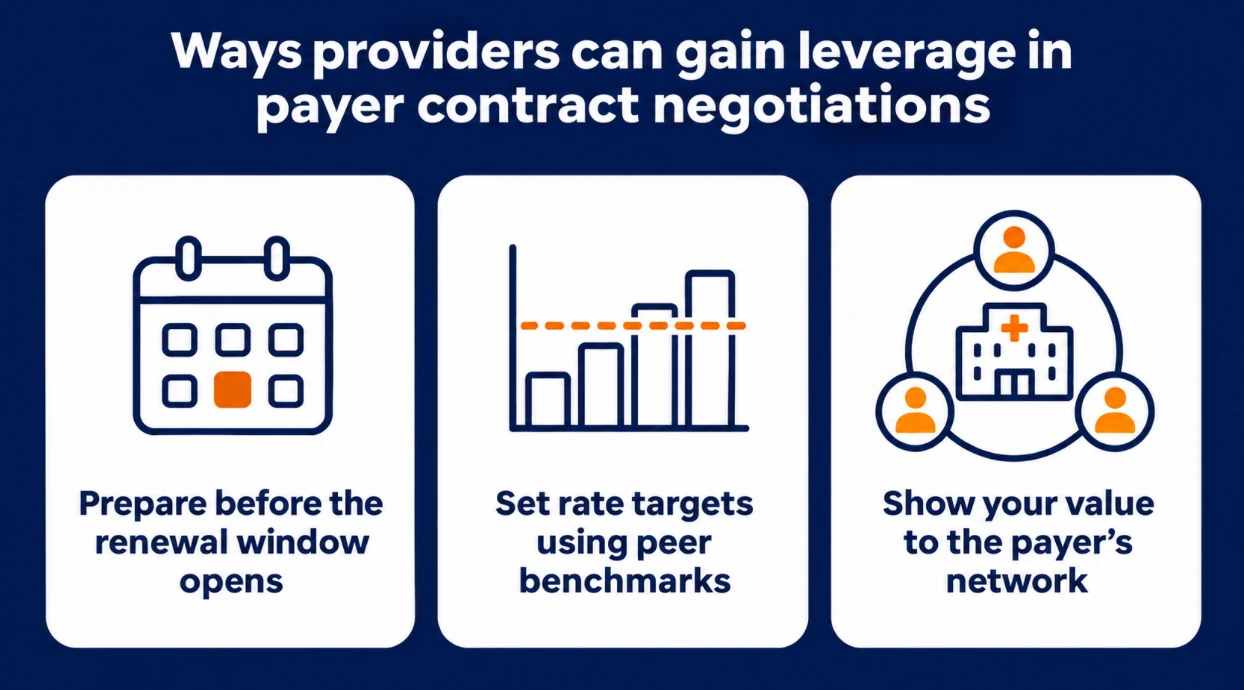
Start Before the Renewal Window Opens
Review your payer agreements together. For each one, identify when the rates were last negotiated, when the contract renews, and the deadline for giving notice. Work backward from that deadline so your team has time to review the fee schedule, model proposed changes, and agree on a counteroffer. A regular review can also flag an evergreen agreement that might otherwise go another year without discussion.
Set priorities based on what each contract means to your organization. A modest rate gap on an office visit you bill thousands of times a year may cost you more than a much larger gap on a procedure you rarely perform. Applying your claims volume to each proposed rate change gives you a dollar estimate to use when deciding which contracts and services to address first.
Use Transparency in Coverage Data to Set a Rate Target
The New England practice's own contracts showed that its national payers reimbursed substantially less than its regional plans. That finding tells the practice where to investigate. To decide what to request from either national payer, the next question is "What has the insurer agreed to pay other practices in our market for the same service?"
Transparency in Coverage data can help answer that question if you choose the right comparisons. Start with the payer and network you're negotiating with, then match the CPT code, care setting, and type of provider. If your peer group includes both independent practices and practices affiliated with a major health system, consider looking at those rates separately. A single average can obscure a difference that matters to your negotiation. Use the most relevant comparisons to propose a specific rate for each priority service.
Understand Your Leverage with Each Payer
A market benchmark can tell you what a payer has agreed to elsewhere. Your leverage depends in part on what that payer's members and employer clients rely on your organization to provide. If you offer a specialty with few local alternatives, document how many of the payer's members use it and where else they could reasonably go for care. If you perform a procedure in a lower-cost outpatient setting, show what the payer spends there compared with the available alternatives. Quality outcomes can also strengthen the case when they relate directly to the services under discussion.
Consider the relationship from your side as well. How much of your revenue comes from this payer? Which rate changes would make the largest difference to your organization? Or are you pricing yourself out of volume when patients are choosing the lower-cost option? Answering those questions before negotiations begin helps you decide where to hold firm and what you could accept in return for a concession.
Bring Pricing Discipline to Your Next Payer Negotiations
For decades, pricing discipline was difficult because providers lacked access to real market benchmarks. Transparency in Coverage data now gives providers access to information historically only available to payers. Before your next renewal, you can see what the payer has agreed to pay comparable providers, decide which rates to prioritize, and build a counteroffer you can support.